Walking Alongside the Journey: Project HOME’s Certified Peer Special Program
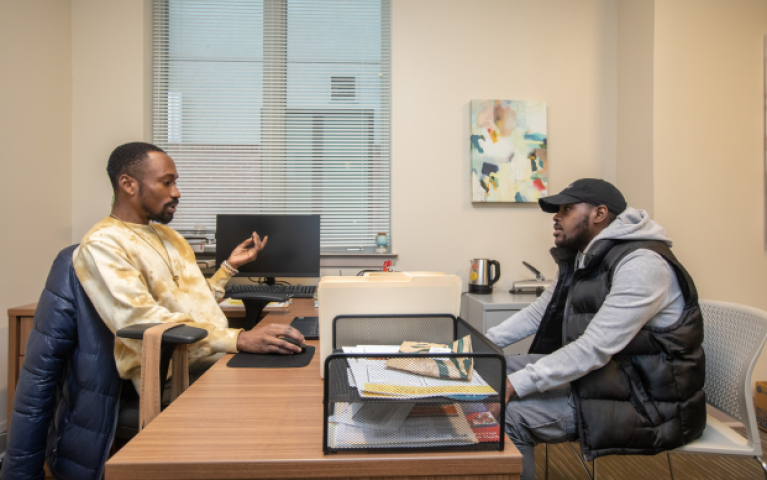
At Project HOME, lived experience is more than a source of understanding. It can become a bridge between someone facing a difficult moment and someone who knows, firsthand, that change is possible. Project HOME’s Certified Peer Specialist (CPS) program brings that belief to life by pairing people navigating mental health challenges, substance use disorder, housing instability, incarceration, and other barriers with trained staff who have traveled similar paths.
The program is led by Marsha Young, Peer Support Services Program Director, who oversees a five-person team that includes a CPS supervisor and four Certified Peer Specialists. Together, they support Project HOME residents and other eligible Philadelphia residents. Participants must have active Medicaid coverage, a history of receiving behavioral health services, and confirmation from a licensed practitioner that peer support could benefit them. Participation is voluntary, and each person decides what they want to work toward.
That choice is central to the program. During the first 30 days, staff complete screenings and learn about the participant’s needs, including behavioral health, substance use, food access, and other social factors that can affect well-being. From there, the peer specialist and participant develop a goal plan together. The plan is not based on what others think the participant should do. Instead, it is built around what the participant says matters most.
“The whole premise of peer support is a supportive program,” Marsha said. “Our team of peer specialists, with this lived experience, walk alongside these participants, and they have firsthand experience.”
Peer specialists are not therapists and do not diagnose or provide clinical treatment. They offer practical guidance, encouragement, and steady companionship rooted in their own recovery and life experience. A participant’s goals might include entering treatment, attending a recovery meeting, reconnecting with family, learning to use public transportation, pursuing a GED or job training, finding housing, or becoming more comfortable in social settings. The program is mobile, so staff can meet participants where they feel most comfortable. This could be accompanying them to appointments and community activities even if the person moves to another residence within Philadelphia.
The team also helps participants navigate systems that can feel fragmented or overwhelming. Peer specialists can bring together case managers, healthcare providers, residential staff, and other members of a participant’s care team, so everyone understands their role. If a participant is hospitalized or incarcerated, the team can visit and assist with discharge planning. The program complements the person-centered case management at the heart of Project HOME’s supportive housing model, which recognizes that a safe home is a critical first step, and that long-term stability also requires attentive, individualized support.
“They have been where the participants are,” Marsha said. “They have firsthand knowledge of what it looks like and what it feels like to be homeless, to be unhoused, to have no income, to suffer with a mental health diagnosis, to be incarcerated, to have a substance use dependency.” That shared understanding can make it easier for someone to speak honestly about needs they may not yet feel comfortable discussing in a clinical or residential setting.
Building the program required patience and careful planning. Project HOME hired Certified Peer Specialists during an early pilot period while the organization developed the structure needed to operate a fully credentialed service. The program received state licensure in September 2025 and credentialing through Community Behavioral Health in November 2025. Staff then built the program into eClinicalWorks, the system used to document services and bill Medicaid. That work was completed in late May 2026, and the program officially went live in the system on July 1, 2026.
For Marsha, who joined Project HOME in early 2026, the opportunity brought together more than 20 years of work with people affected by homelessness, domestic violence, incarceration, mental health challenges, and substance use. After holding executive-level positions in New York City, she wanted to return to work that kept her closer to participants and the day-to-day impact of services.
“What drew me to this program was the uniqueness of it,” she said. “It’s a brand-new program.” The role allows her to shape policies and procedures while seeing how those decisions affect people in real time. “It’s not just the mission on paper,” she added. “We really do the work that we say we’re here to do.”
Paul Chapman saw that work from the program’s earliest stages. Before becoming a Residential Services Coordinator at Project HOME, Paul was a Project HOME resident. He first learned about CPS training from a sign in an elevator offering residents the chance to take the classes with Project HOME covering the cost. He applied, earned his certification, and spent about two years working as a Certified Peer Specialist during the pilot period.
Paul brought decades of personal experience with addiction, homelessness, and recovery to the role. He had returned to school to earn his GED at age 60, and becoming a CPS gave him a way to turn hard-earned lessons into support for others. “It was giving me an opportunity to come alongside other men and women who have been in similar situations,” he said. “I wanted to be able to encourage them that if I can make the changes in my life, they could too.”
While the program’s formal systems were still taking shape, Paul looked for ways to create connections. He started a men’s support group, a game day where residents cooked, ate, and spent time together, and a 10-week group called Heart of Addiction. The gatherings gave people room to talk about their struggles without shame and to experience the kind of community that can help sustain recovery.
Paul also helped introduce the CPS program at other locations and spoke with potential participants, including people preparing for reentry after incarceration. To him, the value of peer support was immediate. “Men and women who are in these positions of homelessness or coming out of jail, they need other men and women who have been in similar situations to come alongside them and be a beacon of hope,” he said. “My desire is to be that beacon.”
His own career reflects the opportunity he hoped participants would see. After serving as a CPS, Paul advanced into residential services, where he continues helping people living with serious mental health challenges. “Project HOME has been a doorway for me to climb this ladder of success,” he said. The program helped him recognize that his experiences could carry value, both for his own growth and for the people who might see part of themselves in his story.
Peer support works because recovery and stability are rarely achieved through instructions alone. Trust grows through consistency, honesty, and the knowledge that the person offering support understands how difficult the next step can feel. The relationship also benefits the peer specialist. Paul said listening to other people’s stories continues to strengthen his own recovery and remind him how far he has come.
“I didn’t want to just sit around and be a victim anymore,” Paul said. “I wanted to overcome some things in my life, and I couldn’t do it sitting around daydreaming. I had to get out and do something. And Project HOME’s CPS program gave me that opportunity.”
Now that the program is fully operational, its future will be shaped by the goals participants bring through the door. Each appointment, recovery meeting, family reconnection, housing application, or first trip across the city can become part of a larger journey toward stability. The peer specialists will be there every step of the way, offering proof that progress is possible and that no one has to make the journey alone.