What is the Point-in-Time Count?
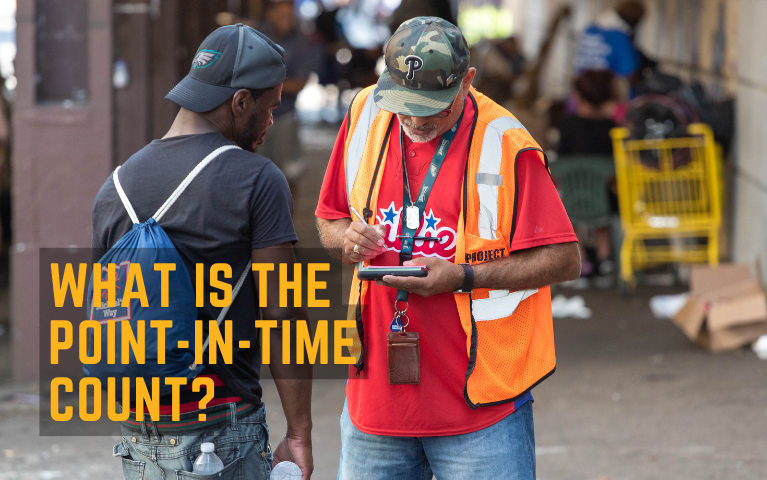
Since 2007, the U.S. Department of Housing and Urban Development (HUD) has required all communities receiving federal homelessness funding to conduct an annual point-in-time (PIT) count of people experiencing homelessness—both sheltered and unsheltered. The PIT count seeks to answer a basic question: how many people are living without housing and where? Conducted every January, the count provides a one-night snapshot of homelessness that helps to inform funding, planning and policy decisions.
What are the limitations of the Point-in-Time Count?
A One-Night Snapshot
While the PIT count provides valuable information, it has well known limitations, particularly for estimating the number of people who are unsheltered. Conducted on a single night in January, the count often coincides with harsh weather that drives people indoors—to a friend’s couch, an abandoned building, or other hidden locations, where they can be very hard to identify.
Street counts of unsheltered homelessness often overlook people who are incarcerated or hospitalized on the night of the count, even if they lacked housing beforehand and will need it when they’re released.
Narrow Definitions
The unsheltered component of HUD’s Point-in-Time Count is also based on the agency’s definition of literal homelessness. Under this definition, an individual or family is considered literally homeless if they “lack a fixed, regular, and adequate nighttime residence,” or if their primary nighttime residence is public or private place “not meant for human habitation.” That includes people who are sleeping on the streets, in vehicles, or in encampments, as well as those staying in emergency shelters or transitional housing. However, this definition excludes many adults over 24 who are doubled up, couch surfing, or temporarily staying with friends or family—even when they lack stable housing.
By contrast, the definition of homeless children and youth under the McKinney-Vento Act is far broader. It explicitly includes children and youth who are sharing another person’s housing due to a loss of housing or economic hardship, living in motels or otherwise lacking a fixed, regular and adequate nighttime residence.
These differences in definition have produced widely divergent estimates. In 2024, HUD’s Point-in-Time Count identified more than 771,000 people in the U.S. who were homeless nationwide on a single night in January. In comparison, the Department of Education, reported that more than 1.3 million children experienced at least one episode of homelessness during the 2022-2023 school year.
Are there other methods to estimate the number of people who experience homelessness?
Since canvassing the street alone might not account for the full scope of people who are homeless, some cities and counties conduct an expanded count or use additional sampling methods to improve accuracy.
Houston, Texas. The Continuum of Care encompassing Houston, TX and its surrounding counties conducts an expanded count to include people in county jails who were homeless at the time of their arrest. In the CoC’s 2017 expanded PIT count, incarcerated individuals accounted for 36 percent of the total homeless population.
New York City. In New York City, the Homeless Outreach Population Estimate, or HOPE Count, divides the city into high-density and low-density areas, using data collected from homeless outreach programs throughout the year. Counts are conducted in all high-density areas, where street homelessness is visible and known to occur, while only a random sample of low-density areas is counted. Data from those samples are then used to estimate unsheltered homelessness in the remaining areas, producing a more accurate measure than relying on observational street counts.
Minnesota. There are also methods of estimating the scope of homelessness beyond the PIT count. Every three years, the Minnesota Homeless Study, surveys shelter residents on how many nights in the previous month they slept outside in coordination with the annual PIT count. Compared to a one-night count, the 2023 study found higher rates of unsheltered homelessness when asking shelter residents where they slept during the past 30 days.