Chronic Homelessness: Facts on Homelessness
Chronic Homelessness
In January 2025, 1,612 adults were identified as chronically homeless on a single night in Philadelphia. The U.S. Department of Housing and Urban Development (HUD) defines chronic homelessness as having a disabling condition and being homeless continuously for at least one year, or experiencing four or more episodes of homelessness within the past three years totaling at least 12 months. Chronically homeless adults represent 29 percent of everyone experiencing homelessness in our city, up from just 9 percent in 2007. This shift tells a complex story: overall homelessness has dropped sharply over the past two decades, but the people left behind are those with the greatest needs. Learn more about chronic homelessness in Philadelphia.
Chronic Homelessness in Philadelphia
A Changing Landscape
Homelessness has declined sharply in Philadelphia, dropping from more than 7,600 people in 2007 to just above 5,500 people in 2025. Yet during that period, chronic homelessness has increased significantly, both in number and as a share of the total number of people who are experiencing homelessness in our city.
- In 2007, only about 9 percent of the people who were homeless in Philadelphia were considered chronically homeless.
- By 2025, that share more than doubled to 29 percent, representing more than 1,000 adults.
This shift suggests that while fewer people are homeless in Philadelphia overall, those who remain are increasingly individuals with long-term and complex needs.
A closer look reveals another important trend—the location of chronic homelessness has shifted dramatically. In 2007, six out of ten chronically homeless Philadelphians were unsheltered. Today, nearly 75 percent are staying in emergency shelters, safe havens or transitional housing programs, while 25 percent remain unsheltered. This shift into sheltered settings is a meaningful sign of progress as well as our shared success in prioritizing those with the greatest needs. Our challenge now is to build on that progress by scaling access to permanent supportive housing.
Why Permanent Supportive Housing Matters
For many people, homelessness is a housing problem caused by the gap between our household incomes and the rising cost of rent, but for people who are chronically homeless, the presence of a disabling condition can make finding and keeping a home much more challenging.
Permanent supportive housing (PSH) is a proven, cost effective solution that ends chronic homelessness by combining safe, affordable housing with wraparound services. Those services include case management, recovery support for substance use, healthcare for chronic physical and mental health conditions and access to educational programs and job training to foster long-term independence.
Without permanent housing, however, people who are chronically homeless often cycle through costly public systems—emergency rooms, hospitals, shelters and the criminal justice system. Permanent supportive housing interrupts that cycle.
A 2025 study by HealthShare Exchange (HSX) found that residents of Pathways to Housing PA who had been stably housed for one year or more had fewer emergency room visits, shorter hospital stays, and more outpatient care, when compared to their own experience prior to being housed. Researchers estimated that permanent supportive housing reduced hospital losses by $1,000 per emergency room visit and $2,400 per hospital day avoided.
Proof That It Works
Communities across the country have demonstrated that we can end chronic homelessness.
Case Study: Bergen County, NJ
In 2017, Bergen County, New Jersey became the first community in the country to end chronic homelessness. Bergen County achieved this milestone by adopting a housing first model, centralizing intake services, streamlining data systems, and expanding permanent supportive housing.
Between 2007 and 2017, when the county reached functional zero, the number of year-round permanent supportive housing beds grew by nearly 300 percent through a mix of scattered site apartments and placed-based developments. These coordinated efforts enabled Bergen County to connect individuals to housing in an average of just 64 days, effectively eliminating chronic homelessness.
Case Study: Rockford, IL
Rockford, Illinois also achieved functional zero for chronic homelessness in 2017 by applying a Housing First approach and modernizing its data systems to better track and coordinate services. A key component of this strategy was the expansion of permanent supportive housing (PSH). Between 2007 and 2017, Rockford increased its supply of year-round PSH beds by 154 percent, creating both scattered-site and place-based options to meet the needs of their community. By combining low-barrier access to housing with improved data-driven coordination, Rockford demonstrated that we can end chronic homelessness.
What is Project HOME doing to end Chronic Homelessness in Philadelphia?
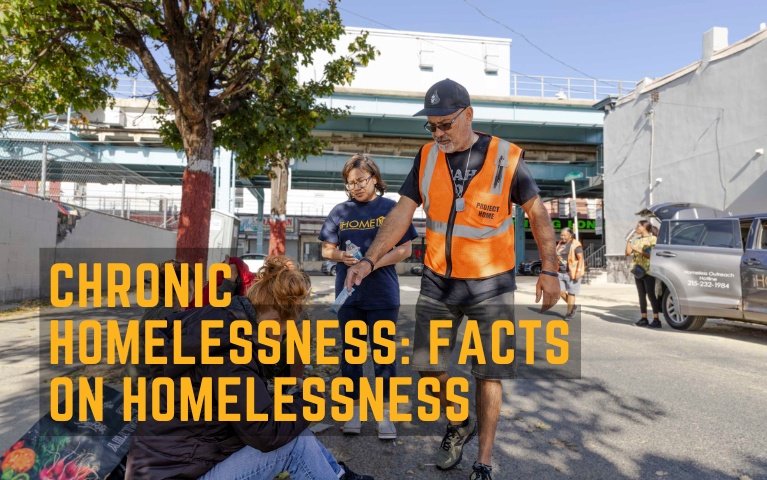
Project HOME addresses chronic homelessness in Philadelphia by combining compassionate outreach with long-term housing solutions. Our street outreach and medical teams serve as vital links between people who are unsheltered and the permanent housing and supportive services they need to achieve stability. To date, Project HOME operates over 1,000 units of housing across Philadelphia, including 850 units of permanent housing. Of those 850 units, 192 are earmarked for individuals who meet the federal definition of chronic homelessness. These homes provide not only a safe place to live but also access to healthcare, recovery support, education, and employment services that help residents rebuild their lives. For more information on permanent supportive housing at Project HOME, see a list of our housing locations here.
Additional Resources
- Peng et al., (2020). Permanent Supportive Housing with Housing First to Reduce Homelessness and Promote Health among Homeless Populations with Disability: A Community Guide Systemic Review. J Public Health Manag Pract., 26 (5)
- A comprehensive review of 26 studies in the U.S. and Canada found that Housing First PSH decreased homelessness by 88 percent and improved housing stability by 41 percent.
- National Alliance to End Homelessness, Ending Chronic Homelessness Saves Taxpayers Money.
- A compilation of studies found that it costs taxpayers an average of $35, 578 for chronically homeless individuals to remain unhoused. When those same individuals receive supportive housing, costs on average are reduced by 49.5 percent.
- Tsemberis et al., (2012). Housing Stability and Recovery Among Chronically Homeless Persons With Co-Occuring Disorders in Washington, DC. American Journal of Public Health, 102 (1).
- A 2-year HUD funded project found that Housing-First Permanent Supportive Housing led to significant reductions in psychiatric symptoms in the first year of housing for chronically homeless and severely disabled individuals. Demand for costly Assertive Community Treatment (ACT) rehabilitative services was reduced to less costly and intensive community supportive services for 14 percent of clients.
- Aubry et al., (2020). Effectiveness of permanent supportive housing and income assistance interventions for homeless individuals in high-income countries: a systemic review. Lancet Public Health, 5(6).
- A meta-analysis of 72 studies in the U.S. and Canada found that permanent supportive housing interventions increased housing stability for both moderate needs and high needs individuals compared to usual care.
- United to End Homelessness, Scattered Site Permanent Supportive Housing as an Effective Solution to End Homelessness
- An explanation of the benefits of scattered site PSH for individuals exiting homelessness, and the differences between scattered-site and place-based models of permanent supportive housing.